































Amid the ever-increasing polarization of U.S. discourse, where the president and so many others slug it out daily in verbal boxing matches over social media, Diablo Valley College is seeking to give younger generations the tools to navigate a sea of online misinformation and AI-generated content.
Recently, the campus hosted the “DVC Viking Middle and High School Invitational,” a formal speech and debate competition held here Nov. 15-16, which challenged roughly 340 students from local schools like James Logan and Archbishop Mitty high schools to a two-day gauntlet of elimination-style verbal bouts.
“A major concern a lot of industry thinkers have is how polarized politics have become, and I think a lot of that has to do with people not doing their own research and people not critically evaluating the information they’re receiving,” said Paul Villa, professor and co-director of DVC’s Speech & Debate program, who helped organize the competition.
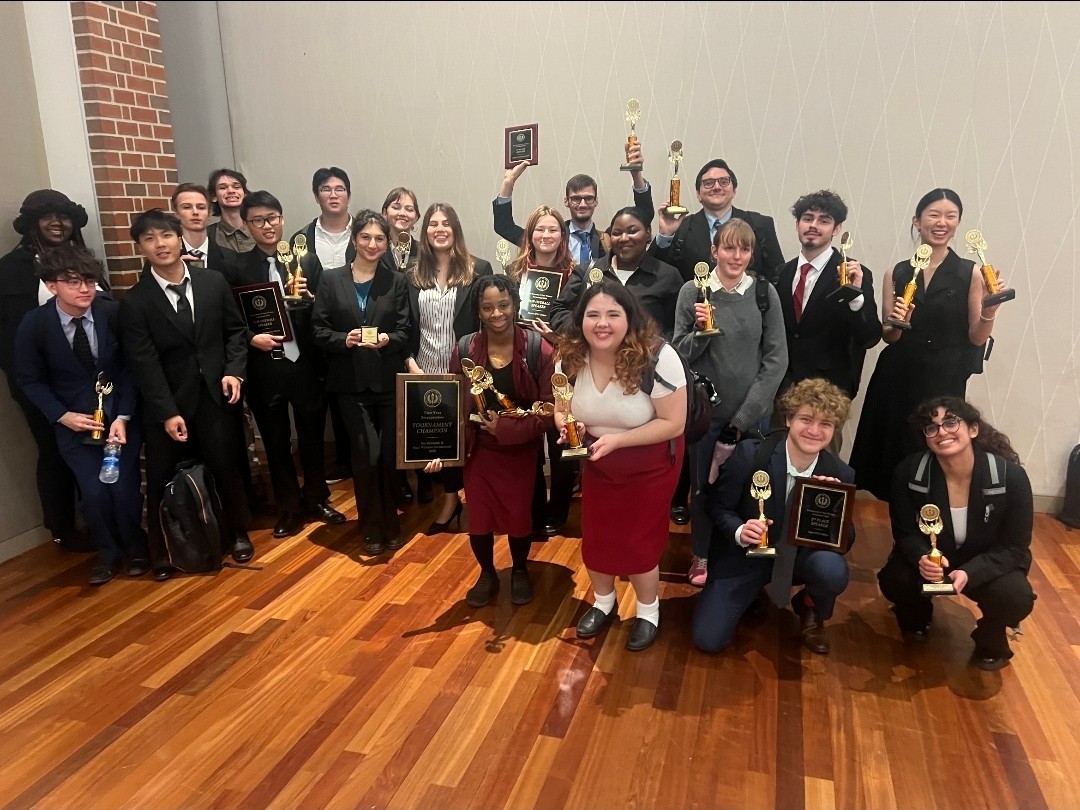
The tournament, designed as a non-profit fundraiser for the department, allowed DVC students who are enrolled in COMM 163: Forensic Speech and Debate to act as judges for the competition. It followed a few weeks after the University of the Pacific’s “Paul Winters Invitational” in Stockton, where DVC’s Speech & Debate team took first place ahead of UC Berkeley and Whitman College.
Isa Renteria, a student attending the invitational from Benicia High School, said participating in speech and debate has strengthened her ability to think critically.
“It helps us, especially as a younger demographic, to be politically aware,” said Renteria.
“We understand what’s happening around us, and we’re also able to understand misinformation a lot easier. We’ll look at the news and be able to point out why someone’s logic is wrong, or when they’re blatantly lying, which is really important in this political age.”
Villa noted that while campus students regularly participate in competitions like this, the event marked the first time in 10 years that DVC had explicitly invited middle and high school students.
He said this provides a unique opportunity for DVC students to experience the judging aspect of the competition without having to forfeit their future eligibility to participate, while giving “quality feedback” to their juniors.
“If you ever judge a college competition as a college student, you actually have to forfeit your eligibility [to compete] forever,” explained Villa.
“There’s some unique benefits to being a judge as opposed to a competitor. You kind of start realizing when you’re on the other side of the table, ‘Oh wow, a lot of things that people say in debates didn’t factor into my decision.’”
Communication Studies Professor Robert Hawkins, who also helped organize the competition, noted that the COMM 163 class is required to conduct community service events related to speech and debate, making the invitational one that “fulfills one of the curricular goals of the class.”
He also said it provides a low-cost opportunity for students to hone their skills.
“There’s a lot of events that happen at [UC] Berkeley and other places that are sometimes cost-prohibitive for teams to go to,” said Hawkins.
“What we offer here is close, it’s local, and it doesn’t cost a lot. So our prices are really low, and anything that we get, we put back into the tournament.”
During each round of the competition, participants were given 20 to 30 minutes to research their assigned topic. Villa emphasized that the topics each competitor was asked to defend were random, “so you’re frequently asked to defend things you disagree with or don’t believe in.”
“I think that is what teaches people critical empathy, to understand the viewpoints of other people they may disagree with and engage with them rather than retreat from them,” said Villa.
Both Villa and Hawkins confirmed they would like to continue hosting similar events, now that their team is the “biggest it’s ever been” in terms of the number of students participating.
With renewed interest and an increasing budget, Villa said the tournament was a good “seeding” ground for future invitationals and collaborations with other schools.
“Debate is about seeking truth through argumentation and evidence and research,” said Hawkins.
“People coming together in the community to have real, authentic interpersonal interactions like this is super important,” he added.
“These programs are so necessary right now in our rapidly changing world.”