































Have you kept up with the latest releases? I’ve been running off to the theaters almost nonstop in recent weeks, and I’ve discovered that 2025 is shaping up to be an unexpectedly great year for movies.
Ambitious and original horror films like “Sinners” and “Weapons” captured the zeitgeist, “Superman” proved that superheroes aren’t ready to go out of fashion, and polarizing thrillers like “Eddington” and “One Battle After Another” sparked discussions big and small.
Now, the release schedule is speeding up as we go into the holiday season, with more big award contenders like “Hamnet” and end-of-year blockbusters like “Avatar: Fire and Ash.” And amid the cinematic overflow, I wanted to take a moment to tell you about some of the smaller but in many ways remarkable movies you might have missed.
It Was Just an Accident
Iranian filmmaker Jafar Panahi’s Palm d’Or winner, “It Was Just an Accident,” tells the story of a man named Vahid (Vahid Mobasseri) who abducts a seemingly innocent father (Ebrahim Azizi) and prepares to kill him. Vahid believes he has found the man who tortured him in prison years ago, but is it the right man?
Uncertainty creeps up before he can carry out his revenge, and Vahid must spend the next day and night visiting old friends and digging up past wounds in a quest to confirm his captive’s identity.
The film is Panahi’s latest act of defiance against the regime in his country. In 2010, Iran’s government banned him from making films for 20 years, and he has continued to work in secret by smuggling out new films for the last 15 years. He was imprisoned in 2022, released after a hunger strike in 2023, and is still fearlessly challenging his country’s oppressive censorship.
“It Was Just an Accident” begins as a stark thriller, then gradually morphs into a dark comedy. Vahid accumulates an unlikely party of collaborators on his mission, including a bride and groom and their wedding photographer, and is pulled into some very unexpected situations along the way. A running gag involves the group’s shortage of petty cash; there is casual institutional corruption everywhere, and practically everyone expects a bribe.
The final scenes are devastating. Panahi films the climax in a bravura single take, capturing incredible pain and sorrow from his performers, and ends on an ambiguous note. We’re left to wonder about the morality and consequences of the choices made, and to question whether the past ever truly heals. Panahi isn’t just criticizing a regime — he’s looking at how ordinary people survive one.

Nouvelle Vague
Richard Linklater’s second great period piece of the year, following “Blue Moon” (which is also worth a look), “Nouvelle Vague” recreates the making of Jean-Luc Godard’s groundbreaking 1960 French New Wave classic, “Breathless.”
Shot in black-and-white, in French, on the same model camera as the original, Linklater lovingly and authentically captures the heady atmosphere of 1960s Paris, when cinema practically defined world culture and young artists everywhere were starting to rewrite the traditional rules of filmmaking.
Every part in the film is unbelievably well-cast. Most of the actors are first-timers who uncannily resemble their real-life counterparts, with no use of makeup or prosthetic effects. Guillaume Marbeck, as Godard, is so dead-on it’s spooky. The Academy might need to invent an Oscar for casting this year and give it to this film.
It’s probably one that will have more appeal for die-hard cinephiles, but there’s enough here to hook an initiate, too. You might not know every name and obscure reference, but you’ll understand enough to enjoy yourself. And the more you know, the more you’ll enjoy.
Godard’s eccentric and mercurial working methods are portrayed with the same type of affection and humor you find in a movie like “Ed Wood,” except this time the director is a genius. But nobody in the film knows that, and they aren’t aware they’re making a classic. That’s what makes it so entertaining.
Godard drives cast and crew crazy, one moment working so fast they can barely keep up, and the next arbitrarily calling off filming for the day before completing a single shot. His instructions are often contradictory and incomprehensible. It’s easy to understand why the people around him are asking themselves if he even knows what he’s doing.
But soon, the thrill and anxiety of working on such an unusual project take over, and everyone starts to experience a funny sort of joy through Godard’s spontaneity and brazen disregard for filmmaking convention. Linklater invites us in and lets us share the fun.
Die My Love
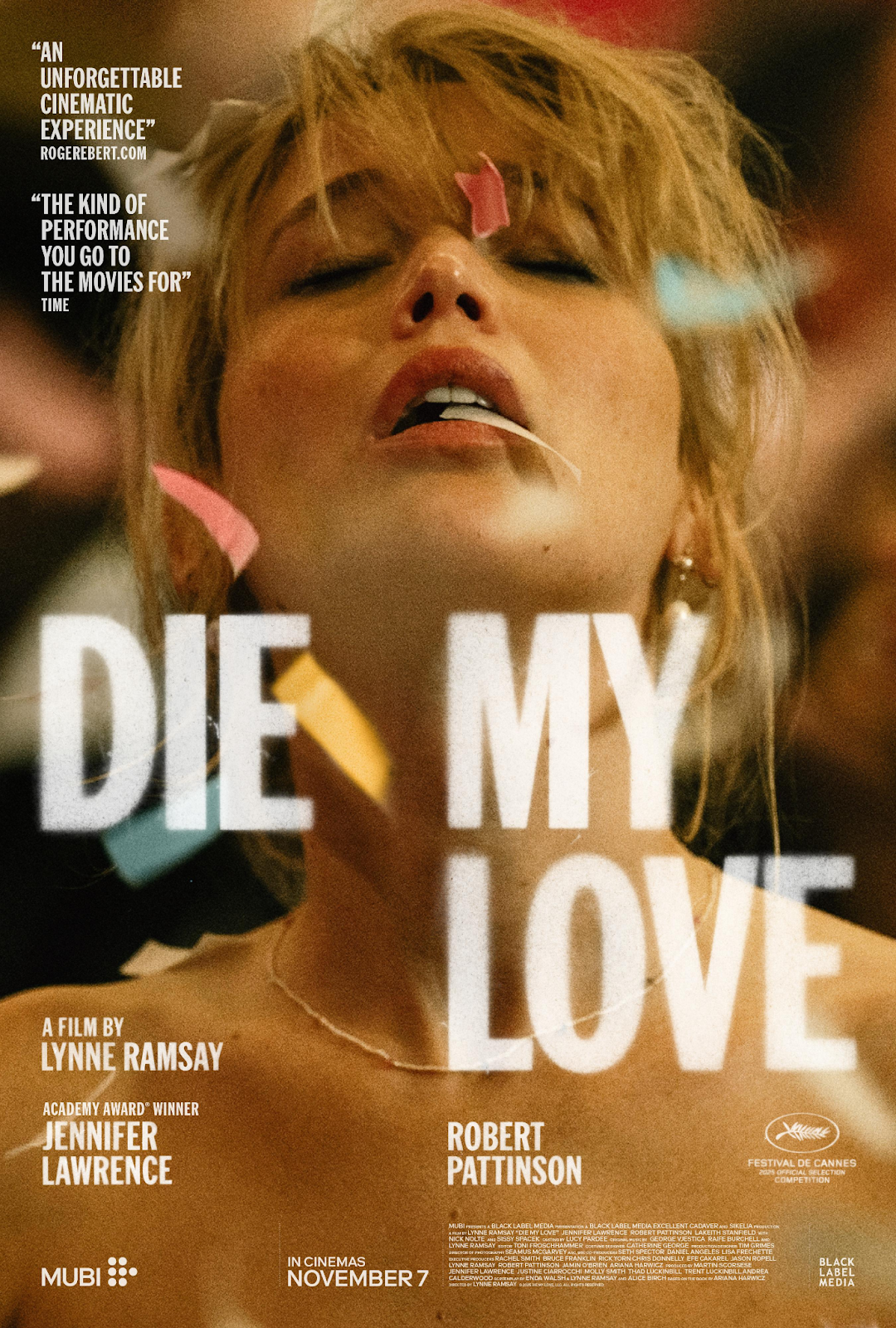
The latest from Scottish auteur Lynne Ramsay (“We Need to Talk About Kevin”), “Die My Love” stars Jennifer Lawrence as Grace, a woman who begins mentally unravelling after moving with her boyfriend and baby to a house in rural Montana.
Ramsay’s uncompromising vision offers no explanation for Grace’s illness and places the viewer inside her subjective experience. The minimal narrative is sometimes nonlinear, sometimes made up of dreams and hallucinations. We get no indication when we’ve departed from objective reality; although when things get really strange, we can assume we aren’t exactly supposed to trust what we are seeing.
It’s challenging, and reviews have been understandably polarized. I was left struggling to understand what I had just seen, and I’m at something of a loss trying to properly describe it. About the only thing I know for certain is that there’s tremendous talent on display.
Ramsay has an inventive and impulsive style. She creates a strong feeling of apprehension and Southern Gothic darkness, then trips up expectations with odd moments of comedy. One scene that blindsided me involved an abrupt jolt of violence caused by a condom and a horse. No, really! This is a movie where you just never know what’s going to happen next.
Lawrence has an incredibly tough part to play. Grace is volatile, enigmatic, and not always sympathetic. She’s a puzzle with missing pieces. We can’t fully understand her, but she still has to suggest enough emotional depth to feel like a real person, even when she’s literally clawing the walls. Lawrence doesn’t flinch for a second and invests the role with everything she has. There won’t likely be a more go-for-broke performance this year.
Robert Pattinson adds a complimentary note of delirium as Jackson, her overwhelmed, none too helpful, and maybe also not too bright boyfriend. Against all logic, he’s helplessly determined to continue loving Grace no matter how erratic and extreme her behavior becomes. Ramsay allows his motivations to remain almost as mysterious as her own.
After digesting the movie for a few days, I found myself appreciating its fearlessness more and more. Extraordinary moments abound, and I’m willing to bet it’ll be a work that grows in stature over time. See it with a fellow movie buff, and afterwards, have a discussion about the provocative approach and the emotional impression it leaves.